
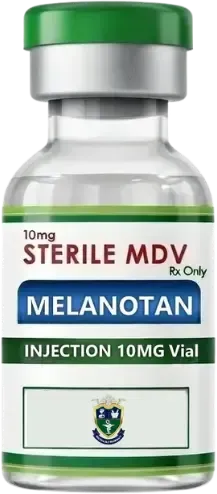
Tan Skin + UV Protection
Melanotan I or II
Stimulate melanin production, darken skin tone, and support UV photo-protection.
No Insurance Required
Ships from USA Pharmacy
Free Medical Consultation
Syringes Included
No Subscription Required
🚫Shipping Restrictions: Pharmacy can NOT ship directly to the following states: Alabama, California, DC, Louisiana, Massachusetts, Michigan, Mississippi, Montana, Texas, Washington, and West Virginia.
Licensed Provider
Licensed Pharmacy
HIPAA Compliant
LegitScript Certified
Overview
Pharmacology
Synthesized analog of alpha melanocyte stimulating hormone, a naturally occurring peptide that signals melanocytes to produce and release eumelanin, the pigment responsible for darker skin tone.
Mechanism of Action
Binds to the MC1 receptor on melanocytes to stimulate eumelanin production via activation of tyrosinase and other melanogenic enzymes, resulting in increased skin pigmentation and tanning independent of UV exposure.
Injection
Administered subcutaneously.
Information presented here is for educational purposes only and not intended to replace or substitute guidance from a healthcare provider. Compounded products are not FDA-approved nor evaluated by the FDA for safety, efficacy, or quality.
Melanotan I vs. Melanotan II
Two distinct analogs of α-MSH with different receptor profiles, potency levels, and clinical applications. Find the right fit for your goals.
|
Melanotan I
Afamelanotide
|
Most Popular
Melanotan II
MT-II
|
|
|---|---|---|
| Pharmacology | ||
| Peptide Structure | Linear α-MSH analog | Cyclic α-MSH analog |
| Receptor Binding | Selective MC1R agonist | MC1R, MC3R, MC4R, MC5R |
| Half-Life | ~1.5–2.5 hours | ~30–60 minutes |
| Administration | Subcutaneous injection | Subcutaneous injection |
| Tanning & Skin Effects | ||
| Melanin Stimulation | Strong | Very Strong |
| Tanning Speed | Gradual — builds over weeks | Faster — noticeable within days |
| Pigmentation Pattern | Even & balanced | Uneven — spotty patches possible |
| Tanning Without UV | Yes | Yes |
| UV Photo-Protection | Yes | Yes |
| Uniform Skin Tone | Yes | Not Guaranteed |
| Additional Effects | ||
| Libido / Sexual Function | Minimal | Significant (MC4R) |
| Spontaneous Erections (Men) | Uncommon | Reported |
| Appetite Suppression | Minimal | Mild (MC4R) |
| Tolerability & Side Effects | ||
| Nausea | Mild / Uncommon | Moderate — esp. initial doses |
| Facial Flushing | Occasional | Common at higher doses |
| Fatigue | Mild | Mild |
| Overall Side Effect Burden | Lower | Moderate (dose-dependent) |
| Best Suited For | ||
| Primary Goal | Pure pigmentation & UV protection with minimal systemic effects | Tanning + libido support + broader systemic activation |
| Side-Effect Sensitive Patients | Preferred | Start low & titrate slowly |
| Seeking Libido Benefits | Not Ideal | Recommended |
Benefits
Tan Skin
Melanotan activates MC1R receptors on melanocytes, triggering the body's own production and release of eumelanin to darken skin tone — achieving a natural-looking result without prolonged sun exposure.
UV Photo-Protection
Increased melanin in the skin provides a natural defense against UV radiation by absorbing and dispersing UV energy, reducing the risk of UV-induced damage to skin cells.
Uniform Skin Tone
By stimulating melanin production systemically through MC1R activation, Melanotan supports even pigmentation across skin, independent of localized UV exposure patterns.
Individual results may vary. Benefits described are based on clinical and pharmacological evidence and do not constitute a guarantee of treatment outcomes. All treatment requires evaluation and approval by a licensed provider.
Simple. Medical. Personalized.

Medical intake
Answer a few online questions about your health history, lifestyle, & goals. No clinic visits required.
Provider evaluation
A licensed medical provider reviews your intake to determine the safest, personalized treatment.


Personalized plan
Custom treatment plan built around your unique health needs, goals, medical history, & biology.

Ongoing support
Stay connected with your care team for follow-ups, adjustments, & expert answers 100% online.
FAQs
Does Melanotan require a prescription?
Yes. Melanotan is a compounded prescription medication requiring a valid prescription from a licensed healthcare provider. A telehealth consultation and medical intake are required before dispensing to confirm suitability, evaluate skin type and pigmentation history, and screen for all relevant contraindications.
What are the possible side effects?
Melanotan is generally well tolerated at prescribed doses. Common side effects may include nausea, facial flushing, and mild fatigue — particularly during initial dosing as the body adjusts to melanocyte stimulation. Spontaneous erections have been reported in male patients due to central receptor activity. Injection site reactions may occur. Skin darkening beyond the intended effect or uneven pigmentation has been reported in some patients. Any change in the appearance of a pre-existing mole or pigmented lesion during treatment should be evaluated by a dermatologist promptly.
Who should not use Melanotan?
Melanotan is not appropriate for patients with a personal or family history of melanoma or dysplastic nevi without explicit dermatologist clearance. Patients with pigmentation disorders, photosensitivity conditions, or hormone-sensitive cancers should discuss use with their provider before initiating. It is not appropriate for patients who are pregnant or breastfeeding, those under 18, or those with significant hepatic or renal impairment. Patients with a history of cardiovascular conditions should disclose this, as Melanotan can influence blood pressure and heart rate.
Are there any drug interactions?
Formal drug interaction studies have not been conducted. Patients on medications that affect blood pressure, heart rate, or sexual function should discuss concomitant use with their provider, as Melanotan may have additive or interactive effects in these areas. Concurrent use of photosensitizing medications may amplify UV sensitivity during treatment, requiring additional sun protection measures. Always provide a complete medication list before beginning treatment.
Is Melanotan safe if I have a pre-existing medical condition?
Patients with a personal or family history of melanoma or those with numerous or atypical moles must not use Melanotan without dermatologist evaluation and explicit clearance. Those with hormone-sensitive conditions, cardiovascular disease, or significant renal or hepatic impairment require individualized provider assessment. All eligible patients should have a thorough skin evaluation before starting and perform regular self-examination of pigmented lesions throughout treatment.
Start Your Journey
Your Skin. Your Tone.
Your Protocol.
Physician-supervised. Delivered to your door.
No clinic visits required.
Licensed Provider
Licensed Pharmacy
HIPAA Compliant
LegitScript Certified
Optimize Your Protocol
These treatments work synergistically with your current protocol to accelerate results and improve long-term outcomes.
PT-141
$200
GHK-Cu
$250
Stella+
$220

© 2026 TestosteroneShots.com, PC
text (323)-283-9219
638 1/2 N. Robertson Blvd, West Hollywood, CA 90069
Legal

The information and products provided on this website are for educational and wellness purposes only and are not intended to diagnose, treat, cure, or prevent any disease. All treatments require evaluation and approval by a licensed healthcare provider through a telemedicine consultation. Individual results may vary, and products carry potential risks and side effects. Certain products may not be evaluated by the U.S. Food and Drug Administration (FDA) unless explicitly stated. Services are provided by licensed physicians and nurse practitioners in states where they are authorized to practice, including California, Florida, Nevada, and other participating states. This service is not intended for medical emergencies. If you are experiencing an emergency, call 911 or seek immediate medical care. We take reasonable measures to protect personal health information in accordance with applicable privacy laws, including HIPAA. By using this website or its services, you agree to our Terms of Service, Privacy Policy, and Telehealth Consent. You must be 18 years of age or older to use this service. We do not manufacture, handle, or ship medications.