
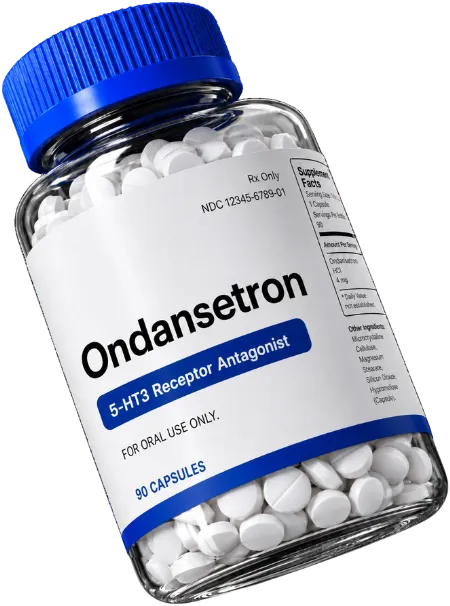
Nausea + 5-HT3 Antagonist
Ondansetron
An FDA-approved selective 5-HT3 receptor antagonist delivering fast, reliable nausea and vomiting control for peptide and GLP-1 protocol side effects, post-procedural nausea, and treatment-related GI symptoms through central and peripheral serotonin blockade.
No Insurance Required
Ships From USA Pharmacy
Free Medical Consultation
No Subscription Required
Licensed Provider
Licensed Pharmacy
HIPAA Compliant
LegitScript Certified
Overview
Ondansetron (Zofran)
Ondansetron is an FDA-approved selective serotonin 5-HT3 receptor antagonist with one of the strongest antiemetic safety and efficacy profiles available. Originally developed for chemotherapy-induced nausea, it is widely used for nausea associated with GLP-1 agonist therapy, peptide protocols, opioids, post-operative states, and vestibular disturbance. Available in 4 mg and 8 mg tablets, with dosing individualized by indication and severity. Ondansetron is hepatically metabolized by CYP3A4 and CYP1A2 with a half-life of 3 to 5 hours and does not cause the sedation, extrapyramidal effects, or tardive dyskinesia associated with older dopamine antagonist antiemetics.
Mechanism of Action
Ondansetron selectively and competitively blocks 5-HT3 receptors in the chemoreceptor trigger zone (CTZ) of the area postrema, in vagal afferent nerve terminals in the GI tract, and in the nucleus tractus solitarius of the brainstem. Nausea from GLP-1 agonists and peptide protocols arises primarily from slowed gastric emptying and vagal 5-HT3 stimulation triggered by elevated serotonin released from enterochromaffin cells in the GI mucosa. Ondansetron blocks this peripheral serotonergic signal at vagal afferents before it reaches the CTZ, and also blocks 5-HT3 activation directly at the CTZ, providing dual peripheral and central antiemetic coverage. Unlike metoclopramide and promethazine, ondansetron does not antagonize dopamine receptors, eliminating the risk of extrapyramidal reactions, sedation, and tardive dyskinesia at therapeutic doses.
Oral Tablet
Taken orally once daily. No injection required.
Information presented here is for educational purposes only and not intended to replace or substitute guidance from a healthcare provider. Compounded medications are not FDA-approved nor evaluated by the FDA for safety, efficacy, or quality.
Benefits
GLP-1 and Peptide Protocol Nausea
Blocks vagal 5-HT3 receptors stimulated by GLP-1-driven gastric slowing and serotonin release from enterochromaffin cells, directly targeting the primary mechanism of GLP-1-associated nausea.
Central Antiemetic
Hypothalamic ER-alpha blockade removes estrogenic negative feedback on GnRH pulsatility, increasing LH and FSH output and drBlocks 5-HT3 receptors in the chemoreceptor trigger zone of the area postrema, preventing the central nausea signal independent of peripheral vagal input.iving testicular testosterone production.
No Sedation or EPS
Selective 5-HT3 antagonism without dopamine receptor blockade eliminates the sedation, extrapyramidal symptoms, and tardive dyskinesia risk of older antiemetic drug classes.
Dose Flexibility
Available in both 4 mg and 8 mg tablets to allow provider-directed dosing matched to nausea severity, protocol phase, and individual patient response.
Rapid Onset
Oral bioavailability and a 30-minute onset allow pre-emptive dosing before anticipated triggers or rapid relief at symptom onset.
Individual results may vary. Benefits described are based on clinical and pharmacological evidence and do not constitute a guarantee of treatment outcomes. All treatment requires evaluation and approval by a licensed provider.
Simple. Medical.
Personalized.

Medical intake
Answer a few online questions about your health history, lifestyle, & goals. No clinic visits required.
Provider evaluation
A licensed medical provider reviews your intake to determine the safest, personalized treatment.


Personalized plan
Custom treatment plan built around your unique health needs, goals, medical history, & biology.

Ongoing support
Stay connected with your care team for follow-ups, adjustments, & expert answers 100% online.
All eligibility is reviewed by a licensed medical professional
FAQs
What is Ondansetron used for?
Ondansetron is an antiemetic medication commonly prescribed to help prevent and manage nausea and vomiting caused by:
GLP-1 medications
Surgery
Chemotherapy
Radiation therapy
Acute gastrointestinal illness
It works by blocking serotonin (5-HT3) receptors involved in triggering nausea and vomiting.
Is Ondansetron the same as Zofran?
Yes. Zofran is the well-known brand name for ondansetron. Generic ondansetron contains the same active ingredient and is commonly prescribed in the United States.
Is Ondansetron prescription-only in the United States?
Yes. Ondansetron requires a valid prescription in the United States and is not currently available over the counter (OTC).
Is Ondansetron legal in the USA?
Yes. Ondansetron is legal in the United States when prescribed by a licensed healthcare provider. It is not classified as a controlled substance.
Can Ondansetron be prescribed online through telemedicine?
In many cases, licensed telemedicine providers may prescribe ondansetron after reviewing your medical history and symptoms, depending on state regulations and clinical appropriateness.
What blood work is required before taking Ondansetron?
Routine blood work is not always required for short-term ondansetron use. However, providers may recommend labs in certain cases, especially for patients with chronic nausea, cardiac conditions, liver disease, or ongoing medication use.
Possible labs may include:
Comprehensive Metabolic Panel (CMP)
Liver function tests
Electrolyte testing (potassium and magnesium)
CBC (Complete Blood Count)
These tests may help identify electrolyte imbalances or other conditions that could increase the risk of side effects.
Does Ondansetron interact with other medications?
Yes. Ondansetron may interact with certain medications that affect heart rhythm or serotonin levels. Patients should disclose all prescription medications, supplements, and medical conditions to their provider before use.
Can Ondansetron cause heart-related side effects?
In rare cases, ondansetron may affect heart rhythm, including QT prolongation, especially in patients with electrolyte imbalances, existing cardiac conditions, or when combined with certain medications.
How quickly does Ondansetron work?
Many patients report symptom relief within 30 minutes to 2 hours depending on the dosage form and individual response.
How long does Ondansetron last?
Effects commonly last between 4 to 8 hours, though this may vary depending on dosage, metabolism, and treatment purpose.
Can Ondansetron help with GLP-1 medication nausea?
Yes. Ondansetron is commonly discussed as supportive therapy for nausea associated with GLP-1 medications such as semaglutide or tirzepatide, although treatment decisions should always be made by a licensed provider.
Is Ondansetron safe for long-term use?
Some patients may use ondansetron longer term under medical supervision. Providers may monitor electrolyte levels, liver health, medication interactions, and symptom progression depending on treatment duration.
Why isn’t Ondansetron available over the counter?
Although widely used, ondansetron remains prescription-only in the United States partly due to concerns involving cardiac rhythm risks, medication interactions, and the importance of evaluating underlying causes of nausea.
Does Ondansetron require a prescription?
Yes. Ondansetron is an FDA-approved prescription medication available in 4 mg and 8 mg tablets. A valid prescription from a licensed provider is required. Available in #7, #14, and #30 counts at the same price per dose for both strengths.
What are the possible side effects?
Headache is the most commonly reported side effect. Constipation may occur with regular use given 5-HT3's role in GI motility. Transient elevation in liver enzymes has been reported. QT interval prolongation is a rare but serious cardiac effect and requires monitoring in patients with pre-existing cardiac conditions or on QT-prolonging medications. Dizziness and fatigue occur occasionally.
Who should not use Ondansetron?
Not for patients with known hypersensitivity to ondansetron or other 5-HT3 antagonists. Congenital long QT syndrome is a contraindication. Not for concurrent use with apomorphine due to risk of profound hypotension and loss of consciousness. Patients on QT-prolonging medications require ECG monitoring and provider evaluation before use.
Are there any drug interactions?
Concurrent use with apomorphine is absolutely contraindicated due to severe hypotension risk. QT-prolonging agents including certain antiarrhythmics, antipsychotics, and fluoroquinolones require provider evaluation given additive QT effects. CYP3A4 and CYP1A2 inducers including rifampin and carbamazepine reduce ondansetron plasma levels. Serotonergic agents including SSRIs and SNRIs increase serotonin syndrome risk with concurrent use.
Is Ondansetron safe if I have a pre-existing medical condition?
Patients with hepatic impairment require dose reduction as ondansetron clearance is significantly reduced; a maximum of 8 mg per day is recommended in severe hepatic disease. Patients with cardiac arrhythmias, electrolyte abnormalities, or those on QT-prolonging medications require cardiac evaluation before use. Patients with phenylketonuria should note that some formulations contain phenylalanine.
Contact Us
Start Your Journey
Ready to Stay on Protocol Without the Nausea?
Physician-supervised. Delivered to your door.
No clinic visits required.
Licensed Provider
Licensed Pharmacy
HIPAA Compliant
LegitScript Certified

© 2026 TestosteroneShots.com, PC
text (323)-283-9219
638 1/2 N. Robertson Blvd, West Hollywood, CA 90069
Legal

The information and clinical services described on this website are for educational and informational purposes only and are not intended to diagnose, treat, cure, or prevent any disease. All treatments require evaluation and approval by a licensed healthcare provider through a telemedicine consultation. Treatment approval is not guaranteed. Individual results may vary, and treatments may carry risks and side effects. Certain compounded medications, wellness treatments, or off-label uses may not be evaluated by the U.S. Food and Drug Administration (FDA) for safety, effectiveness, or quality unless explicitly stated. Testosterone Shots provides telehealth consultations, clinical review, care coordination, lab-related services, membership services, and ongoing treatment management. Testosterone Shots is not a pharmacy and does not manufacture, compound, dispense, sell, handle, warehouse, ship, or collect payment for prescription medication. Testosterone Shots collects payment only for consultations, clinical review, care coordination, lab-related services, membership services, and other non-pharmacy services. If treatment is approved, your prescription may be sent to a licensed pharmacy partner. The pharmacy contacts you directly to complete medication payment and shipping. Services are provided by licensed physicians, nurse practitioners, and/or other licensed healthcare providers in states where they are authorized to practice. This service is not intended for medical emergencies. If you are experiencing an emergency, call 911 or seek immediate medical care. We take reasonable measures to protect personal health information in accordance with applicable privacy laws, including HIPAA. By using this website or its services, you agree to our Terms of Service, Privacy Policy, Notice of Privacy Practices, Telehealth Consent, and Important Safety Information. You must be 18 years of age or older to use this service.