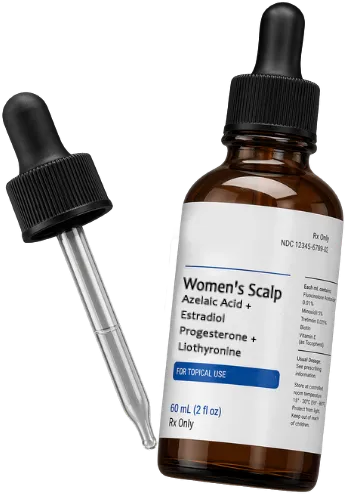
Women's Scalp Solution

Active Ingredients: Azelaic Acid / Estradiol / Progesterone / Liothyronine

Form: Topical scalp solution

Route: Topical application to affected scalp areas

Application: Apply a small amount to affected areas at bedtime; massage thoroughly into scalp

Category: Hair Growth / Female Hair Loss / Hormonal Scalp Therapy / Women's Health

This compounded medication requires a valid prescription from a licensed healthcare provider.

Overview

Female hair loss is fundamentally different from male pattern hair loss — not just in its clinical presentation, but in its biology. Where male androgenetic alopecia follows a predictable DHT-driven script with a relatively uniform hormonal mechanism, female hair thinning is almost always multifactorial: driven by shifting ratios of estrogen, progesterone, androgens, and thyroid hormone that interact with follicular biology in ways that vary across the menstrual cycle, perimenopause, menopause, postpartum recovery, thyroid dysfunction, and individual hormonal variation. A woman whose hair is thinning may be experiencing relative androgen excess as estrogen declines, progesterone depletion removing its anti-androgenic follicular protection, insufficient thyroid hormone activity at the follicular level, or all of these simultaneously — and a treatment targeting only one of these axes will produce incomplete results because it is addressing part of a multi-axis biological problem.

Women's Scalp Solution is a prescription-compounded topical formula combining four actives — azelaic acid, estradiol, progesterone, and liothyronine — that together address the primary hormonal and biochemical axes of female hair loss in a single nightly scalp application. Azelaic acid inhibits 5-alpha reductase to reduce intrafollicular DHT and provides anti-inflammatory and antioxidant activity that supports the overall perifollicular environment. Estradiol restores estrogenic signaling in the scalp — extending the anagen growth phase, opposing androgenic follicular effects, and replacing the estrogen that follicles in perimenopausal and postmenopausal women have lost. Progesterone counteracts testosterone's androgenic effects at the follicular level and independently inhibits DHT production, providing a second anti-androgenic mechanism distinct from and additive with azelaic acid. Liothyronine — active T3 thyroid hormone — stimulates hair growth directly at the follicular level, restoring the thyroid hormone signaling that is essential for normal anagen phase initiation and maintenance and that is frequently suboptimal in women with hair thinning even in the absence of systemic hypothyroidism.

Active Ingredients

Azelaic Acid

Azelaic acid is a naturally occurring saturated dicarboxylic acid found in wheat, barley, and rye and produced by Malassezia yeast on normal skin flora. In concentrations used therapeutically, it is one of the few topical acne actives that operates meaningfully across multiple simultaneous mechanisms — making it the broadest-acting single ingredient in this formula.

Estradiol

Estradiol is the primary and most potent naturally occurring estrogen in premenopausal women, responsible for the sustained estrogenic signaling that supports follicular health throughout the reproductive years. Its role in hair follicle biology is direct and well characterized: estrogen receptors (ERα and ERβ) are expressed in hair follicles — particularly in the outer root sheath and dermal papilla — and their activation promotes anagen phase extension, opposes the androgenic follicular signals that drive miniaturization, and supports the vascular and structural integrity of the perifollicular environment.

Progesterone

Progesterone is the endogenous progestogen that serves a critical but often underappreciated role in follicular anti-androgenic protection — one that is distinct from and additive to both azelaic acid's 5-alpha reductase inhibition and estradiol's estrogenic receptor activity.

Liothyronine (T3)

Liothyronine is the synthetic form of triiodothyronine (T3) — the active form of thyroid hormone that directly regulates cellular metabolism, gene expression, and tissue-level biological activity throughout the body, including in hair follicles. Unlike thyroxine (T4), which requires enzymatic conversion to T3 by deiodinase enzymes before it can activate thyroid hormone receptors, liothyronine is immediately biologically active — making it the appropriate active for targeted topical follicular thyroid hormone delivery where local T3 activity is the therapeutic goal.

Simple. Medical. Personalized.

Medical intake

Answer a few online questions about your health history, lifestyle, and goals — no clinic visits required.

Provider evaluation

A licensed medical professional reviews your intake and determines the safest, most effective option for you.

Personalized plan

Custom treatment plan built around your unique health needs, goals, medical history, and biology.

Ongoing support

Stay connected with your care team for follow-ups, adjustments, and expert answers — all online.

FAQs

How the Four Actives Work Together

Women's Scalp Solution is built around the multifactorial reality of female hair loss — addressing four distinct biological axes simultaneously, in a single nightly application:

Dual anti-androgenic coverage from two independent mechanisms: Azelaic acid inhibits 5-alpha reductase enzymatically, reducing the conversion of testosterone to DHT in scalp tissue — blocking DHT production at its source. Progesterone competitively inhibits androgen receptors in follicular cells and independently inhibits 5-alpha reductase — reducing both DHT production and DHT's ability to activate the follicular miniaturization signaling cascade at the receptor level. Two independent anti-androgenic pathways, covering both DHT synthesis and DHT receptor activation simultaneously.

Estrogenic axis restoration via estradiol: Estradiol restores estrogen receptor-mediated anagen phase extension and follicular androgenic opposition — addressing the loss of estrogenic follicular support that is a primary driver of perimenopausal and postmenopausal female hair thinning. This mechanism is categorically distinct from and non-overlapping with the anti-androgenic activities of azelaic acid and progesterone — estradiol addresses what has been lost, while the anti-androgenic actives address what has become relatively excessive.

Thyroid axis restoration via liothyronine: Liothyronine restores T3-mediated follicular cycling regulation — supporting anagen initiation, metabolic follicular activity, and keratinocyte gene expression through thyroid hormone receptor signaling. This fourth mechanism addresses a biological axis that no amount of anti-androgenic or estrogenic therapy can reach, and that is frequently an unrecognized contributor to treatment-resistant female hair thinning.

Perifollicular environmental support via azelaic acid: Beyond its anti-androgenic activity, azelaic acid's anti-inflammatory and antioxidant properties support the perifollicular tissue environment — reducing the oxidative and inflammatory burden that compounds follicular damage and accelerates miniaturization in women with androgenic and hormonal hair loss. A healthier perifollicular microenvironment allows the hormonal restoration delivered by the other three actives to translate more fully into improved follicular function.

Targeted local delivery with reduced systemic exposure: All four actives are delivered topically to the scalp, concentrating their activity in the follicular tissue where the biological deficits driving female hair loss are located — with substantially lower systemic hormonal exposure than equivalent systemic hormone therapy. This makes Women's Scalp Solution appropriate for women who want targeted follicular hormonal support without initiating full systemic HRT, or as an adjunct to existing systemic therapy where scalp follicles require additional local support.

Potential Benefits

With consistent nightly application as part of a provider-supervised hair health protocol:

Reduced androgenic follicular miniaturization through dual-mechanism DHT suppression — enzyme inhibition (azelaic acid) and receptor-level competition plus independent DHT inhibition (progesterone)

Restored estrogenic anagen phase extension and follicular androgenic opposition through estradiol

Improved thyroid hormone-mediated follicular cycling, anagen initiation, and metabolic follicular activity through local T3 delivery

Reduced perifollicular inflammatory and oxidative burden through azelaic acid's anti-inflammatory and antioxidant activity

Preserved and potentially restored hair density in follicles that remain responsive to hormonal support

Reduced daily shedding as the proportion of follicles in active anagen phase increases relative to resting telogen phase

Improved hair shaft diameter and structural quality as follicular metabolic activity is restored

Targeted four-axis hormonal follicular support with substantially lower systemic hormonal exposure than systemic HRT

A comprehensive hormonal approach to female hair loss that addresses its multifactorial biology rather than a single contributor

Results vary significantly by individual, underlying hormonal profile, duration of hair loss, and follicular reserve at treatment initiation. Female hair loss responds more slowly to treatment than male pattern hair loss in many patients — plan for a minimum six-month treatment course before assessing cosmetic response, and twelve months for full assessment. Initial reduction in shedding is often the first sign of treatment effect, preceding visible density improvement.

How to Use

Apply a small amount topically to the affected areas of the scalp at bedtime.

Application Instructions:

Ensure the scalp is clean and dry before application. Evening application after showering — once hair and scalp are fully dry — is ideal, maximizing overnight contact time.

Part the hair to expose the thinning or affected scalp regions targeted for treatment — typically the crown, midline part, and any other areas of visible thinning.

Apply a small amount of solution — as directed by your provider — directly to the affected scalp areas using the applicator or dropper, distributing evenly across the treatment zone.

Using the fingertips, thoroughly massage the solution into the scalp with gentle circular motions, ensuring even coverage and promoting absorption into the perifollicular tissue.

Allow to dry fully. Do not rinse. The solution should remain on the scalp overnight.

Wash hands thoroughly immediately after application. This formula contains hormonal actives — estradiol, progesterone, and liothyronine — that can be absorbed through skin contact. Minimize hand contact with the solution and wash promptly after each application.

Resume any styling or other scalp products only after the solution has fully absorbed, if applicable.

Bedtime application is strongly preferred — overnight contact time maximizes absorption of all four actives, aligns with the skin's naturally increased nocturnal permeability, and keeps the solution undisturbed on the scalp during peak overnight follicular repair activity.

If a dose is missed: Apply when remembered on the same day, or resume the regular schedule at the next planned application. Do not double-apply to compensate for a missed dose.

Duration: Plan for a minimum six-month assessment period before evaluating response. Ongoing nightly application is the clinical expectation — hormonal follicular support requires sustained delivery to maintain its effect. Results diminish if treatment is discontinued.

Precautions and Safety Information

Women's Scalp Solution is a prescription-only compounded medication containing topical hormonal actives — estradiol, progesterone, and liothyronine — and a 5-alpha reductase inhibitor. Full patient counseling is required before initiating therapy.

This formula is designed for use in women. It is not appropriate for use in men or children.

Contraindications:

Pregnancy: This formula contains estradiol, progesterone, and liothyronine — hormonal actives whose safety during pregnancy has not been established for topical scalp application. Women who are pregnant or planning pregnancy should not use this product without explicit provider guidance. Discuss use immediately with your provider if pregnancy occurs during treatment.

Breastfeeding: Systemic absorption of topical hormonal actives into breast milk has not been fully characterized. Use is not recommended during breastfeeding without individualized provider evaluation.

Hormone-sensitive malignancies: Estradiol is an estrogen. Patients with a personal history of estrogen receptor-positive breast cancer, endometrial cancer, ovarian cancer, or other hormone-sensitive malignancies must discuss this formula with their oncologist before initiating therapy. The systemic absorption of topical scalp estradiol is substantially lower than systemic HRT, but the risk-benefit decision requires individualized oncological evaluation.

Active thyroid conditions: Liothyronine delivers biologically active T3 — the most potent thyroid hormone form. Patients with hyperthyroidism, thyrotoxicosis, cardiac arrhythmia, or significant cardiovascular disease must not use this formula without explicit specialist evaluation. Topical liothyronine does have systemic absorption potential through the scalp; in patients with thyroid conditions or on systemic thyroid medication, combined exposure requires careful clinical management.

Known hypersensitivity: Patients with documented allergy to any formula component — estradiol, progesterone, liothyronine, or azelaic acid — should not use this product.

Undiagnosed abnormal uterine bleeding: Patients with unexplained vaginal bleeding should be evaluated before initiating topical estradiol therapy.

Potential Side Effects:

Hormonal actives — estradiol and progesterone:

Mild scalp or skin irritation at the application site — localized sensitivity to hormonal vehicle components; typically mild and transient

Rare systemic estrogenic effects (breast tenderness, fluid retention, mood changes) if significant systemic absorption occurs — more likely with large application areas or compromised scalp barrier; report to your provider

Rare systemic progestogenic effects — drowsiness, mood changes — if significant progesterone systemic absorption occurs; typically not expected at scalp application volumes but report if experienced

Liothyronine:

Rare systemic thyroid effects from absorption — palpitations, tachycardia, tremor, anxiety, heat intolerance, or insomnia — in patients with elevated thyroid hormone sensitivity or with larger application areas; report any cardiovascular or thyroid symptoms promptly

Patients on systemic thyroid medication require monitoring of thyroid function tests after initiating topical liothyronine

Azelaic acid:

Mild scalp tingling, itching, or warmth at application — particularly during the first one to two weeks; typically transient and resolving with continued use

Mild scalp dryness or flaking, particularly if used alongside other desiccating scalp products

General:

Transient increase in hair shedding during the first four to eight weeks — follicles transitioning from resting to active growth phase; expected and temporary; contact your provider before discontinuing if this occurs

Contact dermatitis in patients with sensitivity to any formula component or vehicle ingredient

Seek immediate provider evaluation if: cardiovascular symptoms develop (palpitations, chest discomfort, significant tachycardia), thyroid symptoms emerge, systemic hormonal effects are unexpected or significant, or pregnancy occurs.

Drug Interactions

Systemic hormone therapy (HRT): Patients on oral or transdermal estradiol, progesterone, or combined HRT should inform their provider before adding topical scalp hormonal actives — combined systemic and topical exposure requires coordinated clinical management to avoid unintended additive hormonal effects.

Systemic thyroid medications (levothyroxine, liothyronine, desiccated thyroid): Patients on any form of systemic thyroid hormone replacement must discuss topical liothyronine use with their provider. Combined systemic and topical T3 exposure requires thyroid function monitoring and potential dosing adjustment of systemic thyroid medication.

Antithyroid medications (methimazole, propylthiouracil): Topical T3 delivery may partially counteract antithyroid therapy; discuss concurrent use with your endocrinologist.

Beta-blockers and cardiovascular medications: Thyroid hormone can increase cardiac sensitivity; patients on cardiovascular medications should inform their provider of topical liothyronine use.

Oral contraceptives and hormonal contraception: Combined estrogenic and progestogenic exposure from topical scalp formula plus systemic contraceptive hormones requires provider-managed coordination.

Topical scalp treatments: When combining Women's Scalp Solution with other scalp topicals, apply in sequence with adequate absorption time between products. Discuss all concurrent scalp treatments with your provider.

Medications metabolized by CYP enzymes: Estradiol is hepatically metabolized; CYP3A4 inducers or inhibitors may affect its activity. Discuss all medications with your provider.

Storage

Store at room temperature, 68°F – 77°F (20°C – 25°C), away from direct heat, humidity, and light

Keep container tightly closed between uses

Do not freeze

Keep out of reach of children

Do not use beyond the labeled expiration date

If refrigeration is specified on your label, store accordingly

The information and products provided on this website are for educational and wellness purposes only and are not intended to diagnose, treat, cure, or prevent any disease. All treatments require evaluation and approval by a licensed healthcare provider through a telemedicine consultation. Individual results may vary, and products carry potential risks and side effects. Certain products may not be evaluated by the U.S. Food and Drug Administration (FDA) unless explicitly stated. Services are provided by licensed physicians and nurse practitioners in states where they are authorized to practice, including California, Florida, Nevada, and other participating states. This service is not intended for medical emergencies. If you are experiencing an emergency, call 911 or seek immediate medical care. We take reasonable measures to protect personal health information in accordance with applicable privacy laws, including HIPAA. By using this website or its services, you agree to our Terms of Service, Privacy Policy, and Telehealth Consent. You must be 18 years of age or older to use this service.