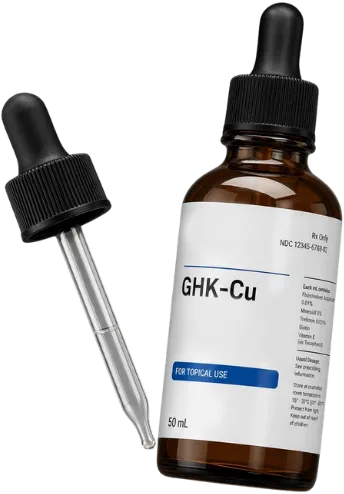
Hair: GHK-Cu

Active Ingredient: GHK-Cu Acetate (Copper Tripeptide-1) 3%

Form: Topical scalp solution

Route: Topical application to affected scalp areas

Application: Once to twice daily, preferably evening on clean, dry scalp

Volume: 60 mL

Category: Hair Growth / Scalp Health / Peptide Therapy

This compounded medication requires a valid prescription from a licensed healthcare provider.

Overview

Hair loss is rarely a sudden event. It unfolds gradually — across months and years — as the biological environment sustaining each hair follicle slowly deteriorates. Perifollicular microcirculation declines, reducing the oxygen and nutrient delivery follicles require for sustained growth. Dermal papilla cells — the specialized fibroblasts that orchestrate each follicle's growth cycle — lose proliferative capacity and become increasingly susceptible to apoptotic signaling. The growth phase of the hair cycle shortens, and the resting phase lengthens. Follicles miniaturize. Hair shafts become finer, shorter, and less structurally robust. And the scalp environment — the extracellular matrix, vasculature, and signaling milieu surrounding each follicle — shifts from one that supports growth to one that tolerates decline.

Most hair loss treatments address a single factor in this cascade. Minoxidil promotes vasodilation. Finasteride blocks DHT. Neither directly targets the follicular cellular biology, the perifollicular extracellular matrix, or the signaling pathways that govern whether a follicle remains in active growth or regresses prematurely.

Hair: GHK-Cu is a prescription-compounded 3% topical scalp solution delivering GHK-Cu Acetate — Copper Tripeptide-1, the naturally occurring human peptide complex that has been identified as one of the body's primary biological signals for tissue maintenance and regenerative repair — directly to the scalp environment where follicular support is needed. Applied daily to affected scalp areas, GHK-Cu engages multiple simultaneously relevant biological pathways: delivering bioavailable copper to activate the enzymes that remodel the perifollicular extracellular matrix; promoting vascular endothelial growth factor expression to enhance the microcirculatory supply to hair follicles; suppressing the cytokine signaling that drives premature follicle regression; stimulating dermal papilla cell proliferation and survival; and engaging the Wnt/β-catenin signaling cascades that are among the most fundamental regulators of hair follicle biology and morphogenesis.

Active Ingredient

GHK-Cu Acetate (Copper Tripeptide-1) — 3%

GHK-Cu is a tripeptide — glycyl-L-histidyl-L-lysine — complexed with copper(II) ions that occurs naturally in human blood plasma, saliva, and urine, where it functions as one of the body's primary endogenous signals for tissue repair, remodeling, and cellular maintenance. Plasma concentrations are highest in early adulthood and decline significantly with age — a trajectory that parallels the progressive deterioration of tissue repair capacity across multiple organ systems, including the scalp.

Copper delivery and enzyme activation

GHK-Cu functions as an efficient copper transporter, delivering ionic copper to cutaneous cells where it serves as a cofactor for copper-dependent enzymes critical to scalp tissue architecture. These include lysyl oxidase — essential for collagen and elastin crosslinking in the perifollicular extracellular matrix — and cytochrome c oxidase, which supports mitochondrial energy production in metabolically active dermal papilla cells. The structural integrity of the perifollicular connective tissue directly influences follicle anchoring, geometry, and the vascular supply that sustains growth-phase follicles.

Perifollicular angiogenesis via VEGF upregulation

In cultured dermal microvascular and fibroblast models, GHK-Cu exposure has been associated with increased vascular endothelial growth factor (VEGF) expression — a finding directly relevant to follicular health, as hair follicles in active growth phase are among the most metabolically demanding structures in the skin and require a robust perifollicular capillary network to sustain their activity. Age-related and androgenic hair loss are both associated with perifollicular microvasculature decline; VEGF-driven angiogenesis represents a mechanism for restoring the nutrient and oxygen delivery infrastructure that growth-phase follicles depend on.

TGF-β1 suppression and anagen prolongation

Transforming growth factor-β1 is a cytokine with documented roles in triggering the transition from anagen (active growth) to catagen (regression) in hair follicles — effectively signaling follicles to stop growing and begin their resting cycle. In vitro studies have shown that GHK-Cu can downregulate TGF-β1 expression, potentially delaying or reducing the premature catagen induction that shortens the growth phase in actively thinning hair. Prolonging the anagen phase means more time for each follicle to produce a full-length, structurally robust hair shaft before entering the resting and shedding phases.

Dermal papilla cell proliferation and survival

The dermal papilla — the specialized cluster of mesenchymal cells at the base of each hair follicle — is the master regulator of follicular cycling and hair shaft production. Its size, cellular density, and signaling activity directly determine follicular output. Separate investigations using human dermal papilla cell cultures have shown that GHK-Cu and related copper peptides can stimulate dermal papilla cell proliferation and reduce apoptotic signaling — findings that, if they translate to the in vivo scalp environment, suggest a mechanism for maintaining dermal papilla vitality and follicular productive capacity in aging and compromised scalp tissue.

Wnt/β-catenin signaling engagement

The Wnt/β-catenin pathway is one of the most fundamental regulatory cascades in hair follicle biology — governing follicle morphogenesis during development, initiating anagen at the start of each hair cycle, and maintaining dermal papilla cell identity and inductive capacity throughout adult life. Preliminary ex vivo data suggest that GHK-Cu may activate Wnt/β-catenin signaling in scalp tissue, engaging a pathway that is directly upstream of nearly all follicular growth regulation. Confirmation in large-scale human scalp tissue studies remains pending, but the mechanistic connection is among the most biologically compelling in the copper peptide hair literature.

Extracellular matrix remodeling

GHK-Cu's established activity in stimulating collagen, glycosaminoglycan, and decorin synthesis — well documented in the skin anti-aging literature — applies equally to the perifollicular dermis, where a well-organized, structurally intact extracellular matrix supports follicular geometry, anchoring, and the organized vascular architecture that supplies each follicle's base.

Historical context

The GHK peptide was first isolated from human plasma, where its natural occurrence as a circulatory tissue-repair signal has been documented for decades. Historical cosmetic and preclinical data have suggested that topical copper peptides may improve hair shaft diameter and reduce shedding. Definitive clinical efficacy in diagnosed hair disorders — including androgenetic alopecia — remains under active investigation, and large-scale controlled clinical trials are currently limited. This formulation is prescribed based on provider clinical judgment that its potential benefits in supporting a healthier scalp environment may outweigh theoretical risks in selected patients.

Simple. Medical. Personalized.

Medical intake

Answer a few online questions about your health history, lifestyle, and goals — no clinic visits required.

Provider evaluation

A licensed medical professional reviews your intake and determines the safest, most effective option for you.

Personalized plan

Answer a few online questions about your health history, lifestyle, and goals — no clinic visits required.

Ongoing support

Stay connected with your care team for follow-ups, adjustments, and expert answers — all online.

FAQs

Potential Benefits

With consistent daily application as part of a supervised hair health protocol, Hair: GHK-Cu supports:

A healthier scalp microenvironment through copper-dependent extracellular matrix remodeling and enzyme activation

Improved perifollicular microcirculation through VEGF-associated angiogenic activity

Potential prolongation of the anagen (active growth) phase through TGF-β1 suppression

Support for dermal papilla cell viability and proliferative capacity

Engagement of Wnt/β-catenin follicular signaling pathways

Reduced perifollicular inflammatory burden through GHK-Cu's documented anti-inflammatory activity

Improved hair shaft diameter and structural quality with consistent long-term use, as suggested by historical cosmetic data

Reduced hair shedding in patients with compromised follicular environments

Support for scalp tissue integrity and perifollicular collagen organization

A biological foundation that complements other hair loss therapies when used as part of a comprehensive provider-supervised protocol

Results vary significantly by individual, underlying cause of hair loss, and treatment duration. Hair follicle biology operates on the timescale of the hair growth cycle — typically three to six months for a single complete cycle. Meaningful cosmetic changes, including improvements in hair density, shaft diameter, and shedding rate, generally require a minimum of three to six months of consistent daily application. Continued use is typically required to maintain any gains achieved. Hair: GHK-Cu is not a replacement for established medical treatments for diagnosed hair loss conditions; discuss comprehensive hair loss management with your provider.

How to Use

Apply once to twice daily, preferably in the evening on a clean, dry scalp.

Application Instructions:

Cleanse the scalp with your regular shampoo and allow to dry completely before applying. Application to clean, dry scalp improves penetration and reduces dilution of the active.

Part the hair to expose the thinning or affected scalp areas targeted for treatment.

Using the included dropper, apply approximately 1–2 mL of solution directly to the affected scalp regions, distributing small aliquots across the treatment area in sections.

Using the fingertips, gently massage the solution into the scalp with circular motions to facilitate even coverage and enhance absorption into the perifollicular tissue.

Do not rinse. Allow to dry and absorb before styling.

Wash hands after application.

Evening application is preferred — allowing the solution to remain undisturbed on the scalp through overnight hours maximizes contact time with the follicular environment and avoids removal by daytime styling products, sweat, or environmental exposure.

If a dose is missed: Apply when remembered on the same day, or resume the regular schedule at the next planned administration. Do not double-dose to compensate for a missed application.

Treatment duration: Plan for a minimum three-to-six-month treatment course before assessing cosmetic response. Hair biology moves slowly — premature assessment leads to premature discontinuation of therapies that require time to produce results. Any deviations from your prescriber's specific instructions should be discussed with your supervising clinician.

Precautions and Safety Information

Hair: GHK-Cu is a prescription-only compounded medication. Patients must be counseled before initiating therapy.

Contraindications:

Known copper sensitivity or allergy: Patients with documented hypersensitivity to copper, copper salts, or copper peptide compounds should not use this product.

Active scalp infection or inflammation: Do not apply to scalp areas affected by active bacterial, fungal (including tinea capitis), or viral infection, or to actively inflamed, broken, or acutely irritated scalp skin.

Wilson's disease or copper metabolism disorders: GHK-Cu delivers bioavailable copper to skin tissue. Patients with Wilson's disease or other diagnosed copper metabolism disorders should not use this product without explicit discussion with their specialist — the clinical relevance of topical copper delivery in these conditions requires individualized medical evaluation.

Pregnancy and breastfeeding: Safety of topical GHK-Cu during pregnancy and lactation has not been established. Consult your provider before use.

Potential Side Effects:

Adverse reactions to topical GHK-Cu are uncommon in published experience and post-marketing reports, and when they occur tend to be mild and localized:

Common:

Transient erythema (redness), pruritus (itching), or mild stinging at the application site — typically resolving with continued use or brief treatment interruption; often most pronounced in the first one to two weeks of use

Less common:

Scalp dryness or flaking, particularly when used alongside other desiccating scalp products or in dry-climate environments; reducing application frequency or adding an emollient adjunct typically mitigates this

Mild transient scalp sensitivity during the initial adjustment period

Rare:

Allergic contact dermatitis with prolonged copper exposure — persistent or worsening inflammation, spreading rash, or vesiculation should prompt discontinuation and medical evaluation

No serious systemic adverse events attributable to topical GHK-Cu have been documented in the published literature to date; however, comprehensive long-term surveillance data remain limited

Note on initial shedding: Some patients experience a brief increase in hair shedding during the first four to six weeks of treatment — a phenomenon observed with several hair growth therapies as follicles in prolonged resting phase are pushed toward cycling activity. This is typically transient and resolves as the treatment effect establishes. Discuss any concerns about increased shedding with your provider before discontinuing.

Discontinue use and contact your provider if: persistent or worsening scalp inflammation, allergic reaction signs, or unexpected systemic symptoms develop.

Drug Interactions

Other topical scalp treatments: Hair: GHK-Cu can be used as part of a comprehensive hair loss protocol that includes other topical agents. When combining with other scalp treatments, apply in sequence with adequate absorption time between products. Discuss all concurrent scalp treatments with your provider to optimize sequencing.

Minoxidil: GHK-Cu and minoxidil address distinct and complementary mechanisms — GHK-Cu targeting follicular biology and extracellular matrix, minoxidil promoting vasodilation and potassium channel-mediated follicular effects. Concurrent use may be prescribed as part of a provider-designed combination protocol; do not self-combine without guidance.

Topical finasteride or spironolactone: Anti-androgenic topical agents may be prescribed alongside GHK-Cu in patients with hormonally driven hair loss; the mechanisms are non-overlapping and complementary. Follow your provider's specific sequencing instructions.

High-dose oral zinc supplementation: Zinc and copper compete for absorption and can mutually reduce bioavailability. High-dose zinc supplementation may theoretically reduce the biological activity of topically delivered copper. Discuss significant zinc supplementation with your provider.

Copper-chelating topical agents: Certain skincare ingredients with copper-chelating properties may theoretically reduce GHK-Cu activity if applied to the same scalp area. Discuss concurrent topical product use with your provider.

Storage

Store at room temperature, 68°F – 77°F (20°C – 25°C), away from direct heat, humidity, and light

Keep container tightly closed between uses

Do not freeze

Keep out of reach of children

Do not use beyond the labeled expiration date

The solution may have a characteristic color from the copper complex — this is normal and does not indicate degradation

Weight Loss

Hormone Replacement

Longevity

Hair Restoration

Sleep

Biohacking

Blood Work

ED

How It Works

FAQs

© 2026, TestosteroneShots.com PC

[email protected]

text (323)-283-9219

638 1/2 N Robertson Blvd, West Hollywood, CA 90069

d

The information and products provided on this website are for informational and wellness purposes only and are not intended to diagnose, treat, cure, or prevent any disease. All medical treatments are subject to evaluation and approval by a licensed healthcare provider through a telemedicine consultation. Individual results may vary, and the use of any product carries potential risks and side effects that should be discussed with a qualified medical professional. These products are not approved by the FDA unless explicitly stated, and misuse or unauthorized sharing is strictly prohibited. By using this site or purchasing any service, you agree to our Terms of Service, Telehealth Consent, and Privacy Policy. We prioritize your privacy and comply with HIPAA regulations for protected health information. Services provided by licensed physicians/nurse practitioners in states served, e.g., CA, FL, and others, via telemedicine. Check your state's telemedicine laws. Must Be 18+ or Older to Qualify For Treatment.